How to Prepare for a Power Outage: A Winter Plan for Simcoe County Homes and Cottages
Knowing how to prepare for a power outage matters in Simcoe County, where ice storms and winter winds can leave homes and cottages dark for days.
It isn’t a rare event here. The March 2025 ice storm brought down trees and power lines across the region, and Orillia, Oro-Medonte and the District of Muskoka all declared states of emergency.
We’re Jecten Electric, a licensed electrical contractor serving Barrie, Simcoe County and cottage country.
By the end of this guide, you’ll know what to do before, during and after a power outage in Barrie, how to run a generator safely, and when a backup generator makes sense for your home.
How to prepare for a power outage: a three-stage plan
To prepare for a power outage, plan for three stages.
- Before: build a 72-hour kit, charge your devices and test your carbon monoxide alarms. During: report the outage, unplug electronics, keep the fridge closed and stay 10 metres from downed lines.
- After: turn appliances on one at a time and have any damaged electrical equipment inspected.
Good power outage preparation comes down to three things: a kit that gets your household through 72 hours, a plan for heat and water, and a safe way to use backup power.
Use this table as your power outage preparation checklist:
Stage | What to do | Why it matters |
|---|---|---|
Before | Build a 72-hour kit, charge phones and power banks, test CO alarms | In a big storm, you may be on your own for a few days |
During | Report the outage, unplug electronics, keep the fridge and freezer closed | Protects your electronics and keeps food cold longer |
After | Turn things back on slowly, check for damage, restock your kit | Avoids a sudden load on your circuits and catches hidden damage |
Before the storm: build a 72-hour power outage emergency kit
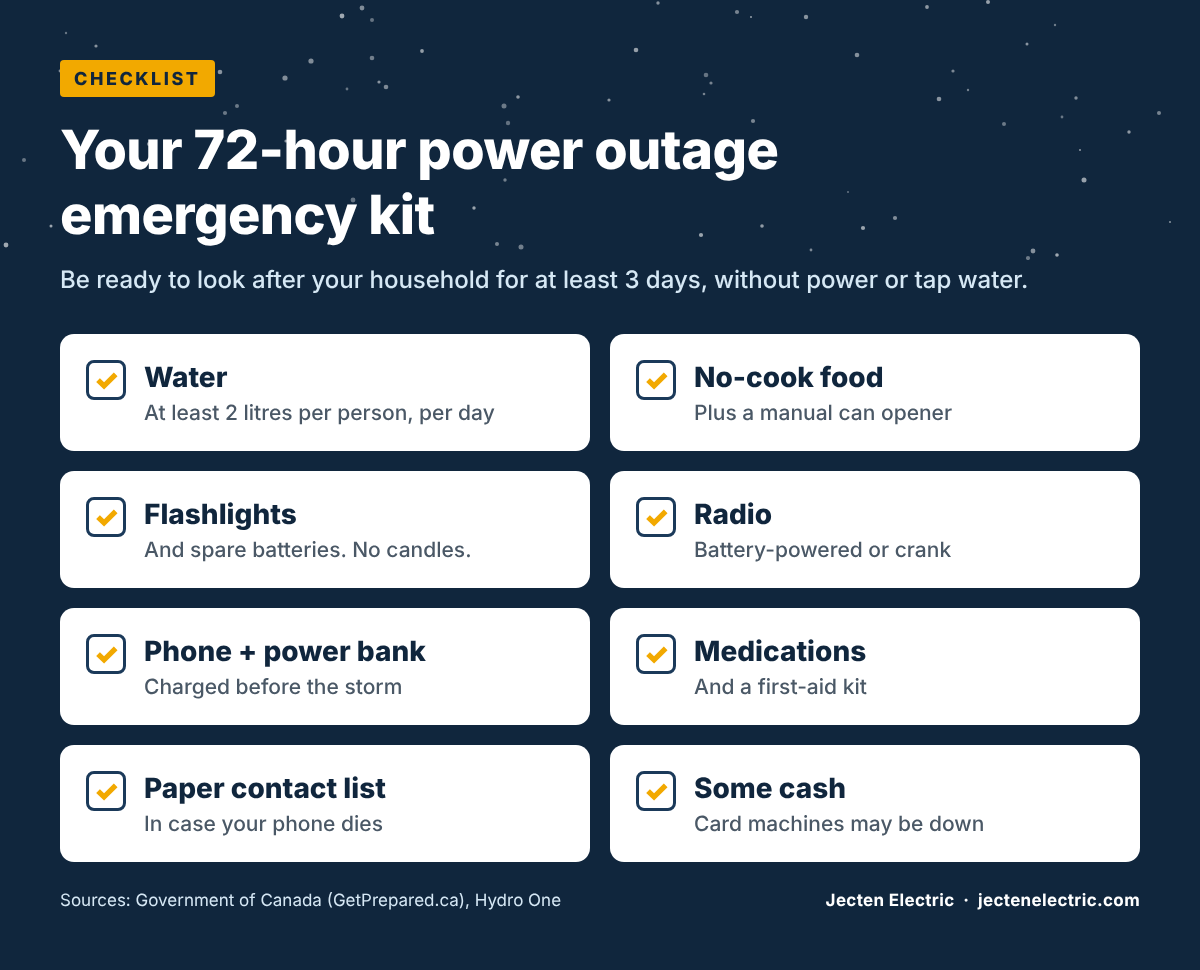
The Government of Canada recommends that every household be ready to take care of itself for at least 72 hours, without power or tap water. That's three days. Pack your power outage emergency kit now, while the roads are clear and the stores are open.
Water: at least 2 litres per person, per day.
Food that doesn't need cooking, plus a manual can opener.
Flashlights and spare batteries. Skip the candles. They're a fire risk.
A battery-powered or crank radio for weather and outage updates.
A charged phone and a power bank.
Medications and a basic first-aid kit.
A paper list of phone numbers, in case your phone dies.
Some cash, since card machines may not work.
Test your carbon monoxide alarms
Outages raise the risk of carbon monoxide (CO) poisoning, because people turn to generators, camp stoves and fuel-burning heaters.
Since January 1, 2026, Ontario's Fire Code has required CO alarms on every storey of a home that has a fuel-burning appliance, a fireplace or an attached garage.
Test your alarms before winter. Make sure they run on batteries or have a battery backup, so they keep working when the power is off.
Know what stops working without power
Some systems in your home do their work in the background. During a long outage, losing them can mean a flooded basement, frozen pipes or no running water.
A standby generator can keep the ones you choose running:
Medical equipment. If someone in your home relies on powered medical equipment, plan backup power with their health care provider.
Well pumps. At many rural homes and cottages, no power means no water from the tap. Store extra water for flushing toilets, too.
Sump pumps. A basement can flood if the pump stops during a thaw or heavy rain.
Furnaces. Most furnaces, including gas furnaces, need electricity to run the fan and controls.
Cordless phones and garage door openers. Keep a corded phone if you still have a landline.
What to do when the power goes out: the first hour
Check if it's only your home. If your neighbours still have lights, check your electrical panel for a tripped main breaker. If the panel is wet, damaged or smells like burning, don't touch it. Call a licensed electrician: (705) 792-8601
Report the outage to your local utility, using a mobile phone. Most utilities, including Hydro One, have an online outage map with restoration estimates.
Unplug TVs, computers and appliances. Turn off your light switches, but leave one light on so you know when the power is back.
Keep the fridge and freezer closed. Health Canada says a full freezer keeps food frozen for about 48 hours, and a half-full freezer for about 24 hours. An unopened fridge keeps food cold for about four hours.
Use flashlights, not candles.
Stay at least 10 metres away from downed power lines. Assume every downed line is live. Call 911, then your utility.
Check on neighbours who are older, less mobile or live alone.
Power outage in Barrie or cottage country? Where to check
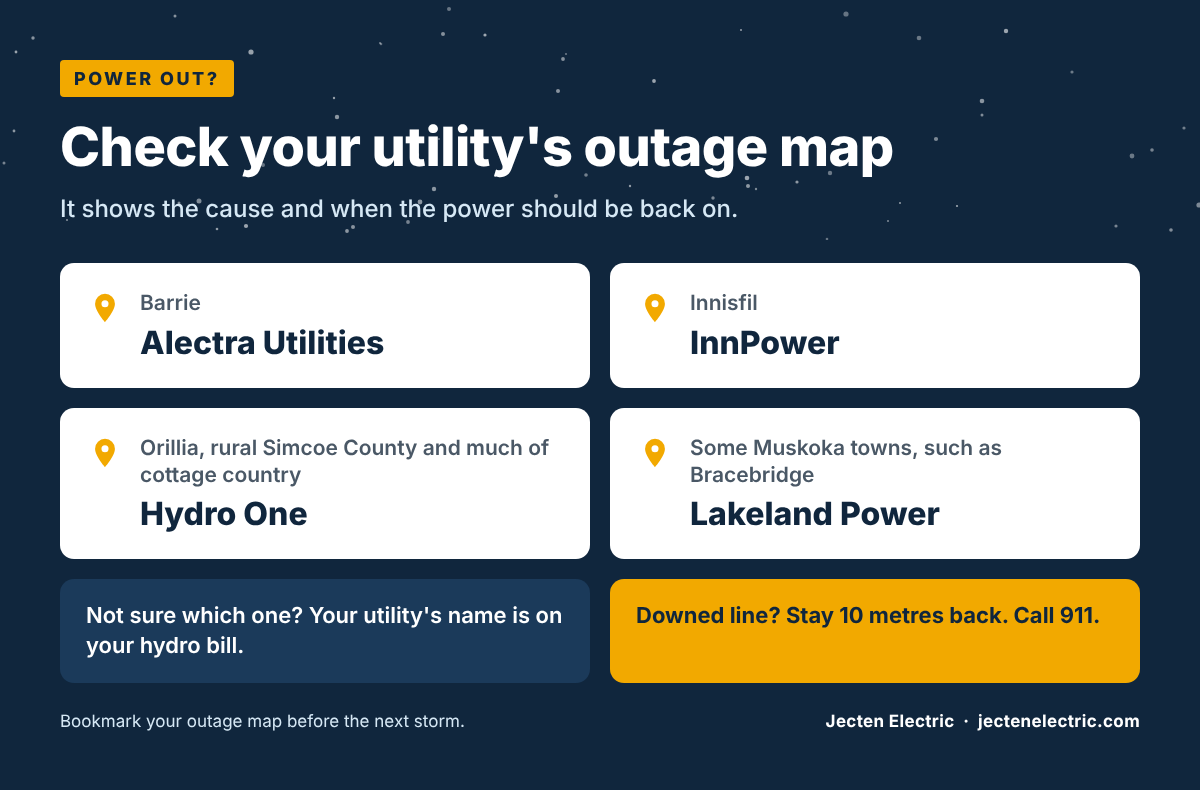
Your utility's outage map is the fastest way to see the cause and the estimated restoration time. Which map you check depends on where you live:
Barrie: Alectra Utilities
Innisfil: InnPower
Orillia and much of rural Simcoe County and cottage country: Hydro One
Some Muskoka towns, such as Bracebridge: a local utility, such as Lakeland Power
Not sure? Your utility's name is on your hydro bill. Bookmark its outage map on your phone before the next storm.
What not to do during a power outage
Don't run a generator, barbecue or camp stove indoors or in the garage.
Don't plug a generator into a wall or dryer outlet.
Don't use candles if you have flashlights.
Don't open the fridge or freezer more than you need to.
Don't go near downed lines or touch a wet electrical panel.
How to run a portable generator safely
A portable generator can keep a fridge, a few lights and your phone chargers going. Used the wrong way, it can kill. These rules come from the Electrical Safety Authority (ESA), Ontario's electrical safety regulator.
Keep it outside
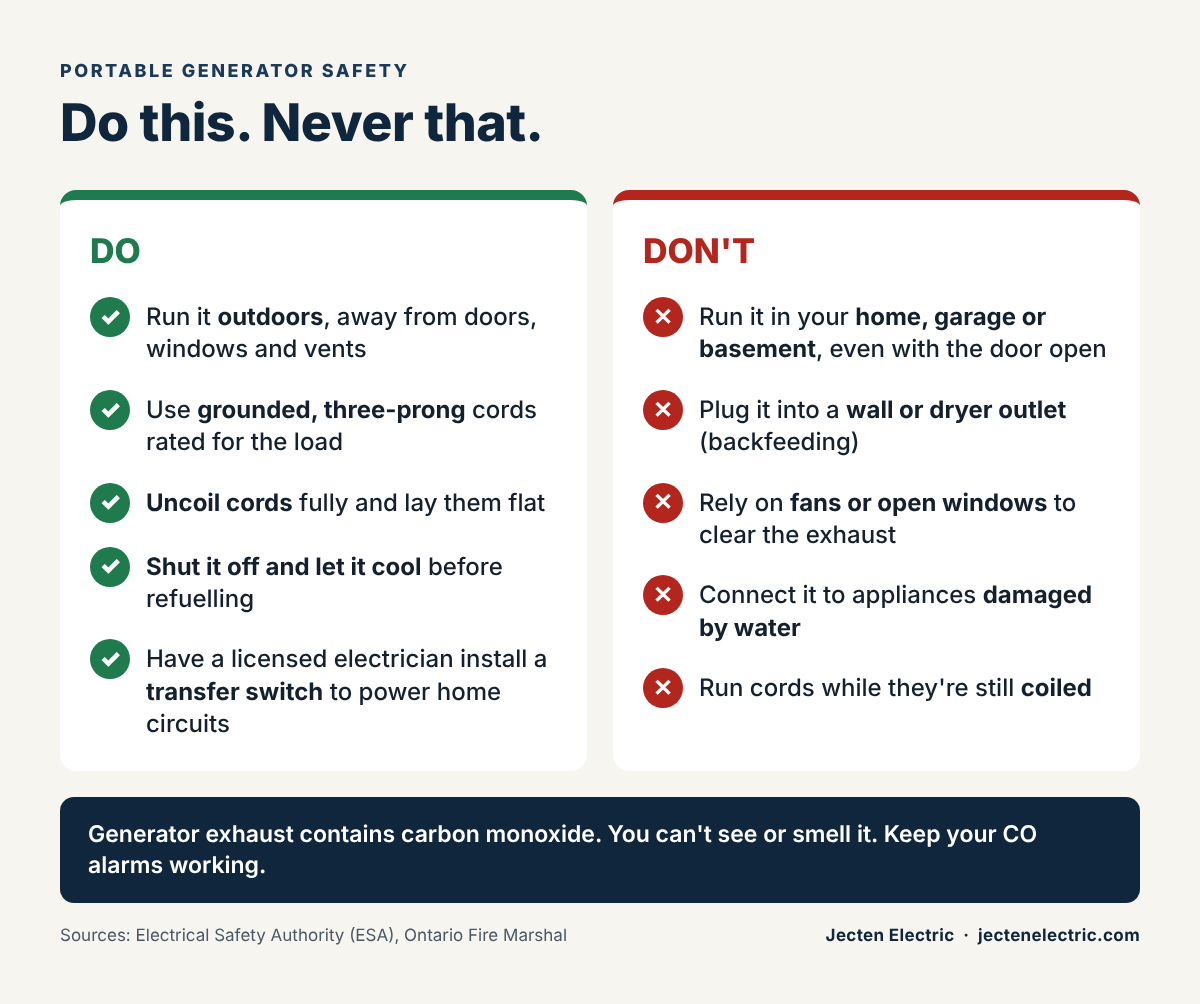
Never run a generator in your home, garage or basement. ESA warns that open doors, open windows and fans are not enough to keep people safe.
Set it up outdoors, away from doors, windows and vents, so exhaust can't drift inside.
Use the right cords
Use grounded, three-prong extension cords that are rated for the load.
Uncoil cords fully and lay them flat. A coiled cord can overheat.
Use a generator transfer switch, never a wall outlet
Some people try to power the whole house by plugging a generator into a wall or dryer outlet with a double-ended cord. This is called backfeeding. It can send electricity back out onto the utility lines, where it puts line crews at serious risk while they work to restore power.
The safe way to connect a generator to your home's wiring is through a generator transfer switch or an approved transfer device. It keeps your house cut off from the grid while the generator runs. Transfer switch installation is a job for a licensed electrician, with an ESA permit.
Refuel with care
Shut the generator off and let it cool before you add fuel.
Store fuel in an approved container, away from your living space.
Portable or standby: which backup power fits your home?
If outages are a regular part of your winter, it may be time to plan for backup power before the next storm. Here's how the two main options compare.
Portable generator with a transfer switch | Standby generator | |
|---|---|---|
How it starts | You wheel it outside and start it by hand | Starts on its own when the power goes out |
How it connects | Plugs into an inlet wired to a transfer switch | Permanently wired with an automatic transfer switch |
Fuel | Usually gasoline | Natural gas or propane |
What it powers | The circuits you choose, such as the furnace, fridge and well pump | Selected circuits or the whole home, depending on its size |
Good fit for | Occasional, shorter outages | Homes and four-season cottages where outages are common, or where someone needs power at all times |
Licensed electrician and ESA permit | Yes, for the transfer switch | Yes |
A standby generator or transfer switch also needs room in your electrical panel. If your panel is full or older, a panel or service upgrade may be part of the job.
For a standby system or a generator transfer switch, see our home generator installation service.
Cottage country: extra steps for seasonal properties
Cottages get hit hard. During the March 2025 ice storm, Hydro One reported about 31,000 outages at secondary properties such as cottages and trailers.
Closed for the winter? An outage at an empty cottage can go unnoticed for days. Ask a neighbour to check in, or use a device that alerts you when the power or heat drops.
Frozen pipes. If heat or heat cable protects your pipes, a long outage can lead to frozen and burst pipes.
Well and septic pumps stop working without power.
Getting there. Ice and fallen trees can block cottage roads. Plan as if you can't get in for a few days.
Four-season cottages are where a standby generator with an automatic transfer switch makes the most sense.
Our cottage electrical services cover Muskoka, Parry Sound, Georgian Bay and the rest of cottage country.
After the power comes back
Turn appliances back on one at a time. This avoids a sudden heavy load on your circuits.
Check your food. If you're not sure something is safe, throw it out.
Look for damage from a safe distance. If your panel is wet or damaged, don't touch it and don't walk through water to reach it. Have it inspected by a licensed electrician.
Watch for warning signs. Flickering lights, warm outlets or switch plates, a burning smell, or breakers that keep tripping all need a professional. If you see smoke or feel heat, leave and call 911.
Restock your kit so it's ready for the next storm.
If something isn't working right after an outage, our electrical troubleshooting and repair services can find the cause.
FAQ
How can I best prepare for a power outage?
Build a 72-hour emergency kit with water, no-cook food, flashlights, a radio, medications and a charged power bank. Test your carbon monoxide alarms, and learn which of your systems need power, such as a well pump, sump pump or furnace. Bookmark your utility's outage map. If outages are common where you live, talk to a licensed electrician about a transfer switch or a standby generator.
What should you not do during a power outage?
Don't run a generator, barbecue or camp stove indoors or in the garage, because the exhaust contains carbon monoxide. Don't plug a generator into a wall or dryer outlet. Don't use candles when flashlights will do, and don't keep opening the fridge or freezer. Stay at least 10 metres from downed power lines, and don't touch an electrical panel that is wet or damaged.
How long does food last in the freezer without power?
Health Canada says a full freezer keeps food frozen for about 48 hours, and a half-full freezer for about 24 hours, as long as the door stays closed. An unopened fridge keeps food cold for about four hours. A fridge or freezer thermometer helps you check. If you're unsure whether something is still safe to eat, throw it out.
Can I plug a generator into a wall outlet to power my house?
No. Plugging a generator into a wall or dryer outlet is called backfeeding. It can send electricity back onto the utility lines and put line crews at serious risk. To power your home's circuits from a generator, you need a generator transfer switch or approved transfer device installed by a licensed electrical contractor, with an ESA permit.
Is it safe to run a generator in the garage with the door open?
No. The Electrical Safety Authority says never to run a generator inside your home or garage, and that open doors, windows and fans are not enough to keep people safe. Generator exhaust contains carbon monoxide, which you can't see or smell. Run the generator outdoors, away from doors, windows and vents, and make sure your carbon monoxide alarms work.
Do I need a permit to install a generator transfer switch in Ontario?
Yes. ESA says a notification of work must be filed before a generator is permanently connected to your home's wiring, and it strongly recommends hiring a licensed electrical contractor. The connection needs a transfer device so power can't flow back to the grid. At Jecten Electric, we file the ESA paperwork and coordinate the inspection for the generators and transfer switches we install.
Get your home ready before the next storm
Whether you need a transfer switch for your portable generator, a standby generator for your home or cottage, or a safety check after a storm, Jecten Electric can help. Call or send a message: (705) 792-8601, or contact Jecten Electric online.
Jecten Electric is an ESA-licensed electrical contractor (ECRA/ESA #7016006) and is fully insured. We pull the permits and coordinate the ESA inspection.
About the author
Chris Kowalski, Master Electrician, Jecten Electric. Chris has more than 20 years in the electrical trade. Jecten Electric is ESA-licensed (ECRA/ESA #7016006) and serves homes, cottages and small businesses across Barrie, Simcoe County and cottage country. Learn more about Chris.